Inside JETT5: Simulating Moonwalks for NASA's Artemis III
NASA's ambitious Artemis program is poised to return humanity to the Moon, with the historic Artemis III mission aiming to land astronauts near the lunar South Pole. This monumental undertaking demands meticulous preparation, not just in spacecraft development and astronaut training, but in simulating every facet of what future moonwalkers will experience. At the forefront of these critical simulations is Dr. Kelsey Young, NASA's Artemis Science Flight Operations Lead, whose expertise is instrumental in bridging scientific objectives with operational realities. Her work, particularly with missions like the Joint Extravehicular Activity and Human Surface Mobility Program Test Team Field Test #5 (JETT5), is shaping how astronauts will explore and discover on the Moon.
The Critical Role of JETT5 in Artemis III Preparation
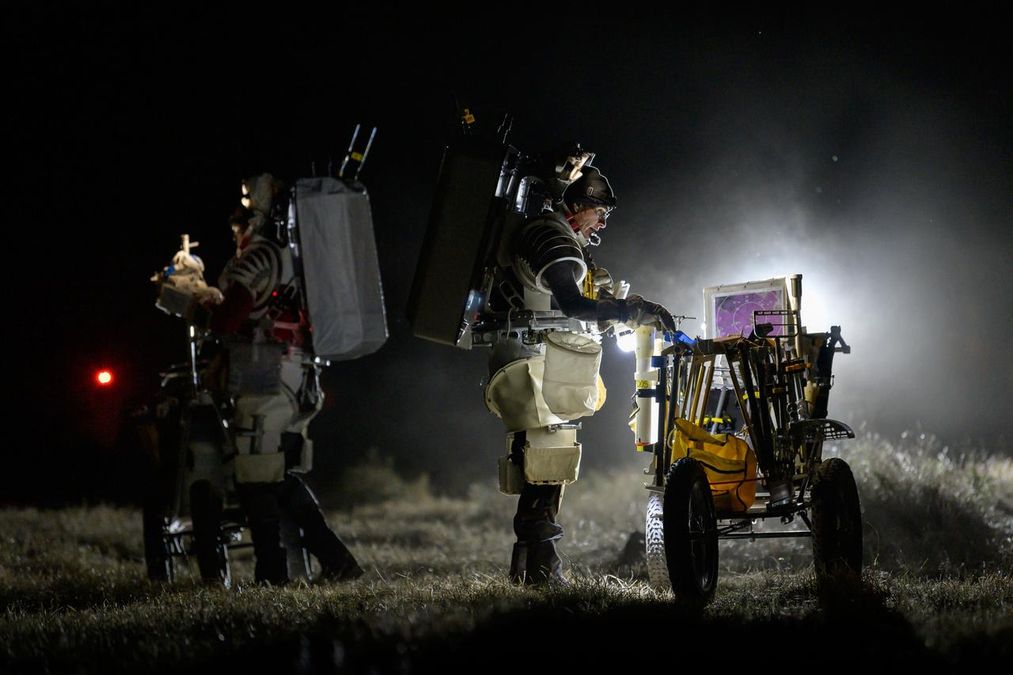
From May 13-17, NASA conducted JETT5, an unprecedented moonwalk simulation designed to hone the skills and procedures for the Artemis III mission. This wasn't just another training exercise; it was the highest-fidelity simulation in a series that began in April 2022, building upon every lesson learned from previous analog missions. The setting for these simulated moonwalks was the San Francisco Volcanic Field near Flagstaff, Arizona. This region, with its rugged, basaltic terrain and scattered volcanic features, offers an excellent terrestrial analog for the challenging and varied landscape expected at the Moon’s South Pole.
During JETT5, astronauts donned specialized spacesuit simulators and conducted a series of planned "moonwalks," meticulously following protocols that will guide their actual lunar excursions. Meanwhile, hundreds of miles away at NASA’s Johnson Space Center (JSC) in Houston, Texas, flight controllers and scientists – including teams under the guidance of
Kelsey Young NASA – provided real-time feedback and direction from a simulated mission control. This integrated approach is paramount. It's not enough for astronauts to perform tasks; they must do so in constant communication with mission control, adapting to instructions, and relaying vital information as if on the lunar surface.
The "Science Evaluation Room" (SER) at JSC became the nerve center for scientific oversight. Here, lunar scientists, geologists, and experts in image analysis and sample science were actively engaged. They directed specific scientific tasks, evaluated the astronauts' progress, and analyzed simulated data, ensuring that the methodologies for lunar surface science and geological exploration were rigorously tested and refined. This collaborative environment ensures that when Artemis III astronauts step onto the Moon, they will be equipped not only with the physical training but also with streamlined scientific protocols for maximizing discovery. For a deeper dive into the preparation overseen by Dr. Young, read
Dr. Kelsey Young on NASA's Artemis III Moonwalk Prep.
Dr. Kelsey Young: Guiding the Science of Lunar Exploration
At the heart of these intricate preparations is Dr. Kelsey Young, the Artemis Science Flight Operations Lead at NASA’s Goddard Space Flight Center in Greenbelt, Maryland. Her role is multifaceted, blending deep scientific understanding with the practicalities of space flight operations. Dr. Young is responsible for ensuring that NASA's ambitious scientific objectives for Artemis are translated into actionable plans for astronauts on the lunar surface. This involves everything from selecting landing sites to developing geological traverses and defining the procedures for collecting invaluable lunar samples.
During JETT5, Dr. Young’s leadership was crucial in orchestrating the scientific teams in the SER. She ensured that the simulated moonwalks were not just physical exercises but rigorous scientific expeditions. Her expertise helps to bridge the gap between pure scientific inquiry and the constraints and opportunities of human spaceflight. For example, understanding how an astronaut in a bulky spacesuit can manipulate tools, collect samples, and describe geological features in a low-gravity, low-light environment requires careful planning and testing. It's this precise integration of science and operations that
Kelsey Young NASA teams excel at.
Dr. Young's contributions extend beyond Artemis III. She also served as the Lunar Science Lead for the Artemis II mission, which successfully launched its Orion capsule for a crucial test flight around the Moon. This experience provided invaluable insights into the crew's operational environment and the logistics of deep-space missions. Her continuous involvement across different Artemis missions highlights her pivotal role in guiding humanity's return to the Moon.
From Earth Orbit to the Lunar South Pole: The Artemis Journey
The Artemis program represents NASA's commitment to sustained lunar exploration, building on the legacy of the Apollo missions. While Artemis II recently demonstrated the Orion capsule's capabilities in Earth orbit and its journey around the Moon, Artemis III will mark the first human landing in over 50 years. This progression is carefully planned, with each mission feeding into the next. The successful launch of Artemis II, which saw its crew's Orion capsule placed on course for a lunar slingshot, provided breathtaking views of Earth and critical data for future missions.
As described by Dr. Young, being inside the Orion capsule, even for short training sessions, offers a profound understanding of the conditions astronauts face. "I have been in it many, many times," she recounted, reflecting on how four individuals, some quite large, will be "crammed together in this tight space for a very long time." This human element is not overlooked; training exercises even involve hanging a giant inflatable moon globe outside the Orion mockup to simulate the crew's observational experience and physical choreography. These seemingly small details underscore the holistic approach NASA takes to astronaut preparation, blending technical training with psychological readiness. Learn more about her role in the orbital mission by reading
Artemis II & Dr. Young: Guiding NASA's Return to the Moon.
The destination for Artemis III, the Moon’s South Pole, is no arbitrary choice. This region is of immense scientific interest due to the potential presence of significant quantities of water ice in permanently shadowed craters. Water ice is a vital resource for future lunar habitats, providing not only drinking water but also oxygen for breathing and hydrogen/oxygen propellant for rockets. Exploring this area presents unique challenges, however, including extreme temperatures, long shadows from a low-angle sun, and rugged, unexplored terrain. Simulations like JETT5 are specifically designed to address these complex conditions, ensuring astronauts are prepared for an environment unlike any previously explored by humans.
The Art and Science of Lunar Analog Missions
Analog missions are indispensable to space exploration. They offer a safe, controlled environment to test hardware, procedures, and human factors before venturing into the unforgiving vacuum of space or onto another planetary body. The San Francisco Volcanic Field, for instance, provides a geological context strikingly similar to parts of the Moon, allowing astronauts to practice identifying features, collecting samples, and navigating rough terrain under conditions that closely mimic lunar operations.
These tests go beyond just physical drills. They are critical opportunities to test communication protocols, decision-making processes under simulated stress, and the seamless integration of diverse teams—astronauts on the ground, flight controllers, and scientists in mission control. JETT5, as the "highest fidelity" simulation, pushed these boundaries further, incorporating advanced scenarios and requiring rapid problem-solving. Each iteration of these tests, from JETT1 to JETT5, builds on previous lessons, refining every aspect of future lunar missions. This iterative process allows NASA to identify potential issues, optimize workflows, and enhance crew safety and scientific productivity. Ultimately, the success of Artemis III hinges on the meticulous groundwork laid by these simulations and the dedicated efforts of leaders like
Kelsey Young NASA.
Conclusion
The journey back to the Moon is a testament to human ingenuity and collaboration. Through rigorous simulations like JETT5, NASA is systematically preparing for the unprecedented challenges and incredible scientific opportunities of Artemis III. The unwavering dedication and leadership of Dr. Kelsey Young, in her role as Artemis Science Flight Operations Lead, are pivotal to this endeavor. By meticulously testing procedures, integrating scientific objectives with operational realities, and preparing astronauts for the unique environment of the lunar South Pole, Kelsey Young and her teams are laying the groundwork for a new era of lunar exploration. As humanity looks forward to seeing boots on the Moon once again, the insights gained from JETT5 and the ongoing work of Dr. Young are bringing that historic moment closer to reality.